Decision Provenance: Trace Design Decisions to Their Source
Decision Provenance: Trace Design Decisions to Their Source
Decision provenance is the preserved chain that shows how a decision was made: the problem observed, the evidence, the options weighed, the choice, and the exact source it came from. For a design team, that means being able to point at a decision and say who agreed to it, why, and in which conversation. A log tells you what was decided. Provenance lets someone else check the reasoning later.
TL;DR
- Decision provenance preserves the context, reasoning and source behind a decision, not just the outcome.
- A decision log lists decisions. An audit trail shows who changed what. Provenance keeps the why and the evidence.
- A useful record has an ID, the decision, date, owner, context, options, rationale, rejected alternatives, evidence, risks, status and a review trigger.
- Link each record to the exact meeting, transcript passage, timestamp or file version it came from.
- Keep it light. Record decisions when someone will later need to know why, and store them where the team already works.
Table of Contents
- What decision provenance means
- Decision log, audit trail and decision provenance
- Why preserving the reasoning matters
- What a decision-provenance record should capture
- An illustrative example from a client review
- Tracking decisions, feedback and open questions as the project evolves
- Recovering context when nobody wrote it down
- Keeping the burden low for students, freelancers and small studios
- Perspective
- Turning conversations into records with The Intent Ledger
- FAQ
- Sources
What decision provenance means
The term comes mostly from data and AI governance, where it describes tracing how inputs flow into outputs. Academic researchers define decision provenance as exposing the pipelines of inputs, decisions or actions, and their flow-on effects, so that systems can be overseen and audited.
The same idea works for a design project. Instead of data pipelines, you have a brief, a critique, a client comment, a site constraint, a revised plan. One practitioner framework, the Provenance of Design, describes the chain as running from the observed problem and evidence, through interpretation and alternatives, to the chosen commitment. It recommends keeping the source close enough that another person can check the reasoning later.
That last test is the useful one. Provenance is not about paperwork for its own sake. It is about whether a person who was not in the room can reconstruct why the project looks the way it does.
Provenance versus data provenance
Most pages ranking for this phrase talk about data lineage: where a dataset was collected, when, and by whom. Decision provenance borrows that discipline and applies it one level up. Data provenance asks where a number came from. Decision provenance asks where a choice came from, and which numbers, comments and constraints it rested on.
Decision log, audit trail and decision provenance
These three get mixed up, and the differences matter when you decide what to keep.
| Record | What it answers | What it usually lacks |
|---|---|---|
| Decision log | What was decided, and when | Why, and the source |
| Audit trail | Who changed what, and when | The reasoning and alternatives |
| Decision provenance | Why this was chosen, against what, based on what evidence, from which conversation | Nothing, if the source link is kept |
Microsoft’s engineering playbook describes a decision log as a Markdown table that summarizes decisions and provides other metadata, acting as an index. That is a useful index. It is not, by itself, the reasoning.
An audit trail is similar. Version history can tell you that a wall moved on a given day and who moved it. It cannot tell you the client asked for afternoon light in the garden. Provenance is the layer that connects the change to the reason.
If you want a starting structure for the index side, our decision log template covers the columns, and our piece on a six-field decision audit trail shows how to tie it to critique-driven work.
Why preserving the reasoning matters
Projects outlive the people who made the early decisions. Interns rotate, project managers change, a freelancer hands off, a studio takes on a new lead. The UK Government Digital Service says decisions should be recorded to preserve context, because people join after the original decision-makers leave and otherwise cannot tell whether a choice was a temporary expedient or reflected an external constraint that still applies.
That is an engineering standard, but the situation is familiar in any design office. A detail that looks arbitrary may be there because of a zoning limit, a budget cut, or a client’s strong preference. Without the reason, the next person has two bad options.
Michael Nygard, in his well-known essay on documenting architecture decisions, describes the pair of failures: blindly accepting an old decision whose context has expired, or blindly reversing one whose hidden rationale still matters. Records of motivation and consequences let a team avoid both.
There is also a challenge benefit. The authors of a piece on ghost decisions in architecture argue that explicit historical context makes foundational choices open to question: the team can ask whether the original constraint still exists instead of treating an undocumented decision as untouchable.
In the governance literature, the same capability is framed as oversight. The 2019 academic paper cited above says decision provenance supports audit, compliance, risk mitigation and user empowerment by making opaque decision pipelines inspectable.
What a decision-provenance record should capture
The open Decision Provenance Standard (version 1.3) lists what to write down. Translated into design-team language, a good record includes:
- A stable ID, so other records and files can refer to it.
- The decision statement, in one or two plain sentences.
- Date and accountable owner.
- Context: the facts that created the need to decide.
- Options considered and rejected alternatives, with the reason each lost.
- Rationale.
- Evidence, with its version or date.
- Assumptions, risks and consequences.
- Status: proposed, accepted, deprecated or superseded.
- A review or re-decision trigger, such as “revisit if the budget changes”.
- Related or superseded decisions.
The Microsoft playbook recommends the same core of title, date, status, context, decision and consequences, and says status should support proposed, accepted, deprecated and superseded states. The GDS adds that consequences should include both positive and negative results, which keeps a record honest.
The rejected alternatives are the part most teams skip and most regret skipping. The Software Engineering Guide’s chapter on decision records specifically recommends recording them, because the why, and not merely the what, is the valuable knowledge.
For a deeper field-by-field walk-through aimed at designers, see our article on the eight fields a record of decision needs.
Linking the record to its source
The field that turns a decision record into provenance is the source link. The standard says to link the record to the exact meeting, transcript passage, timestamp, design-file version, brief section, issue, pull request or commit, to preserve the locator, and to have a reviewer check the surrounding context.
In practice for a design team:
- Cite a meeting by date and a timestamp, not just “the Tuesday review”.
- Quote or point to the specific client comment, not the whole email thread.
- Name the drawing set or model version the decision applied to.
- Mark what you do not know. Leave unknown attendees, dates or attribution as unknown rather than guessing.
That last habit is worth stressing. Guidance on decision tracing says silence or a missing record should stay “unknown” and never be treated as proof that a decision was made. A clean record with a few honest gaps is more trustworthy than a tidy one with invented certainty.
An illustrative example from a client review
Here is a hypothetical example, invented to show the shape of a record. Imagine a small studio designing a house extension.
- ID: D-014
- Decision: Move the extension 1.2 m north of the original position.
- Date and owner: Accepted at the second client review; project lead owns it.
- Context: The client’s brief asks for a garden that stays in afternoon sun.
- Options: Keep the original position and add a taller glazed wall; shift north; shrink the footprint.
- Rejected: Taller glazing, because it raised cost and still shaded the garden; smaller footprint, because it cut a bedroom below the brief.
- Consequence: Longer service run, so a small budget increase. Risk: neighbor’s boundary setback needs checking.
- Source: Review 2 recording, 00:41:10 to 00:46:30, plus the client’s follow-up email.
- Review trigger: Revisit if the setback check fails.
Six months later, a junior designer asks why the extension is not where the first sketches put it. Instead of guessing or interrupting someone, they open D-014, read the reasoning, and jump to the recording. The decision can also be challenged cleanly: if the setback check fails, the trigger is already written down.
A client-presentation workflow described in a public skills repository follows the same pattern: restate the agreed brief, show each design move with its trade-off, identify decisions needed and what work is blocked, then issue a same-day record of what was agreed, rejected and left open. If you are tightening that part of your process, this guide on how to present design concepts for client approval pairs well with a decision record, since the presentation is where many decisions are actually made.
Tracking decisions, feedback and open questions as the project evolves
A single record is useful. A connected set is what gives you project memory. Three habits make the set work.
Keep categories separate. Guidance for meeting minutes recommends keeping discussion, stated information, confirmed decisions, proposed decisions, proposed tasks and open questions distinct. A proposal that was floated is not a decision, and a task someone mentioned is not a commitment until someone owns it.
Link, don’t overwrite. The Decision Provenance Standard describes links among parent, sibling and superseded decisions. When a decision changes, add a new record and mark the old one superseded. History stays visible, and nobody has to wonder when a reversal happened.
Store records where the work happens. The GDS recommends keeping decisions in version control, which preserves what changed, who changed it and when, with application-specific decisions kept alongside the application. Microsoft notes that records can live as pull requests while proposed, with a separate log file as an index. Design teams rarely use pull requests, but the principle transfers: put records beside the files, not in a folder nobody opens.
For more templates and examples, browse our articles on decision-making documentation and project decision records.
Recovering context when nobody wrote it down
Most teams start recording after they have already lost something. You can rebuild some of it.
When the rationale was never captured, one approach from the architecture world is to build a timeline of relevant past events and decisions, then write the findings up as records. The authors of this retroactive method say it makes implicit constraints explicit and gives new team members historical context.
Meeting recordings and transcripts are a rich source. A 2026 research paper on gathering decision records from meetings describes extracting the decision, rationale and rejected alternatives from a transcript, then critically reviewing the draft for missing trade-offs, overlap, noise and duplicated scope. The review step matters: a machine or a rushed human draft is a starting point, not the record.
Research on recovering architectural decisions from issue trackers and version history found it can be done at useful accuracy: the RecovAr tool reported average recall of 75% and precision of 77% on two open-source projects. That is software, not design, but it shows that reconstructing decisions after the fact yields partial results. Recording at the time is far cheaper than recovering later.
Keeping the burden low for students, freelancers and small studios
The fastest way to kill a documentation habit is to ask for a long form after every conversation. The Software Engineering Guide’s advice is to keep records lightweight, specific, dated and discoverable, to write one when someone will later need to know why, and to put it where the team already works.
A workable minimum for a small team:
- Write a record only for decisions that change scope, cost, form or schedule, or that you expect someone to question.
- Use a short template: decision, why, rejected alternatives, source, review trigger.
- Capture within a day, while the conversation is fresh.
- Link, don’t copy. A timestamp beats a pasted transcript.
Students have a specific reason to do this. Illinois Tech’s guidance on student project documentation says strong documentation describes decisions, abandoned approaches and why. Critique is where those happen: a reviewer’s comment, your response, the change you made. Keeping that thread makes a portfolio story far easier to tell.
Freelancers should note the same guidance warns paid or freelance contributors to confirm what client material they may publish. Keep records private by default, and check with the client before showing any of it in a portfolio.
Our pages on decision record templates and why decision records matter go further on keeping this proportionate.
Perspective
We built The Intent Ledger around one observation: design teams rarely lose the what. The drawings, the models and the minutes survive. What disappears is the why, and it disappears the moment the people who heard it move on.
That is why we think of project memory as a record of reasoning, traceable to the conversation it came from. A decision with no source is an opinion someone has to defend from memory. A decision linked to the critique comment, the client remark or the meeting passage is something a new team member can read, test and, if the constraint has changed, responsibly overturn.
Our approach is to turn conversations, notes, transcripts, critique feedback and client comments into structured records of decisions, design intent, risks, actions, commitments and unresolved questions. We design it so that the person doing the work does not have to write a report afterward. Generic meeting notes tools summarize. We aim to preserve intent, and that is a different job.
Rajas
Turning conversations into records with The Intent Ledger
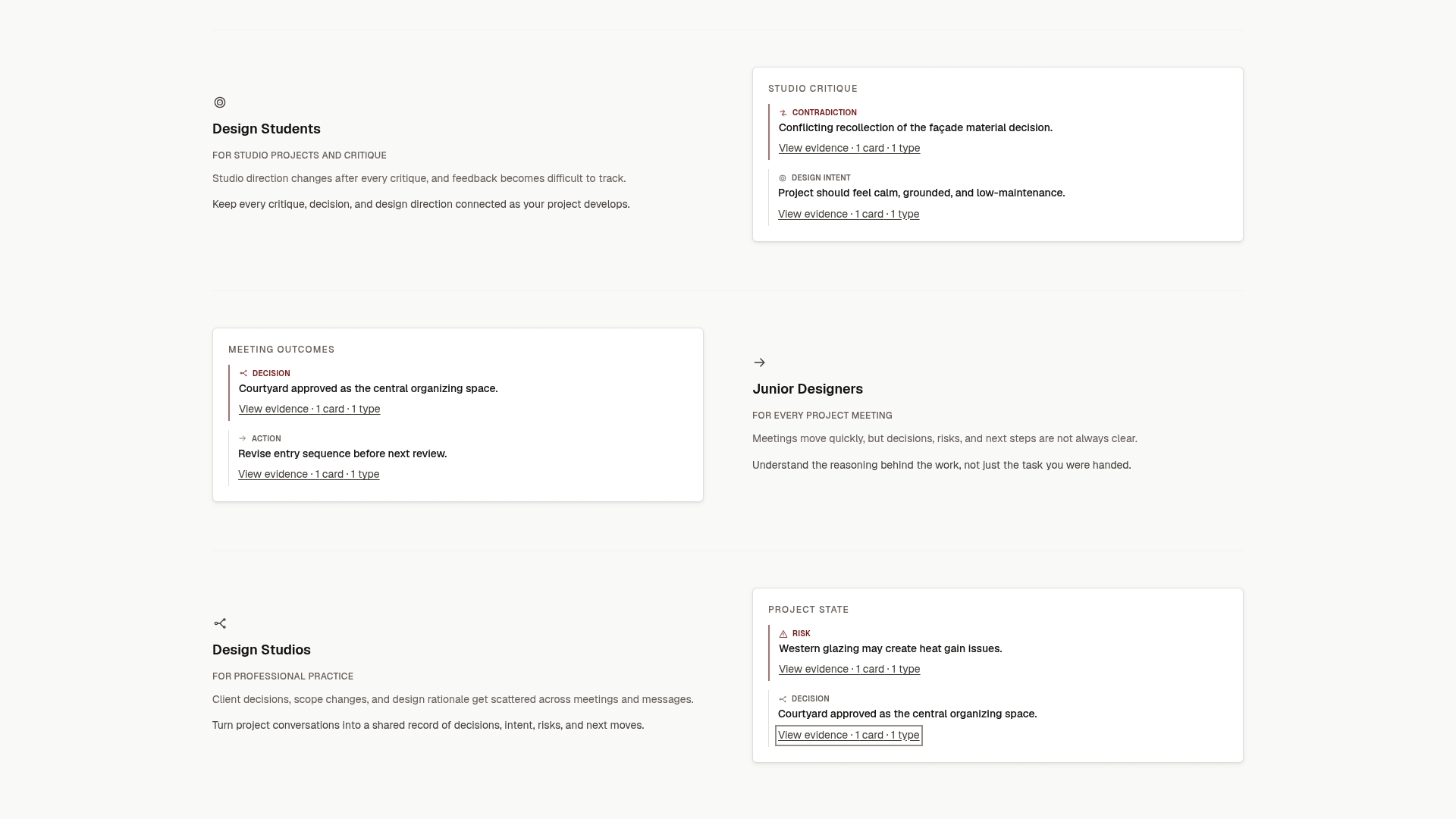
The Intent Ledger is project memory software for design teams. It turns project conversations, meeting notes, transcripts, critique feedback and client comments into ILM Records: structured, source-backed records of decisions, design intent, risks, actions, commitments and unresolved questions, each traceable to the conversation it came from.
If you want to try it on a live project, one-off packs start with Working Set at $12, and Project Record is $29. Monthly plans run from Working Memory at $29 per month to Living Record at $79 per month and Shared Ledger at $149 per month. See all options on the pricing page, or start from the Intent Ledger home page.
FAQ
What is an example of decision provenance?
A record that says the extension moved north, why (the client wanted afternoon sun in the garden), what else was considered and rejected, and where that discussion happened, down to the meeting and timestamp. Anyone can then check the reasoning against the original conversation.
Is decision provenance the same as a decision log?
No. A decision log is an index of what was decided and when. Provenance adds the context, alternatives, evidence and source link behind each entry. Many teams keep a log as the index and provenance records as the detail.
How is decision provenance different from an audit trail?
An audit trail shows who changed what and when. Decision provenance explains why the change was made and what it was based on. You need the trail to see the sequence of events and provenance to understand the reasoning.
How much detail does a record need?
Enough that someone who was not in the meeting could understand the decision, its alternatives and its source. For small teams, a short record with a decision, the reason, the rejected options, a source locator and a review trigger is plenty. Save fuller records for decisions affecting scope, cost or form.
Can I reconstruct provenance for decisions made months ago?
Partly. Build a timeline from emails, recordings, comments and file versions, write the findings up as records, and mark gaps as unknown instead of filling them with guesses. Going forward, record decisions within a day of making them.
Sources
- Decision Provenance: Harnessing data flow for accountable systems
- Chain of Authorship: design decisions, Provenance of Design
- Design Decision Log, Engineering Fundamentals Playbook
- Documenting architecture decisions, The GDS Way
- Documenting Architecture Decisions, Michael Nygard
- Uncovering Ghost Decisions in Architecture
- Decision Provenance Standard, version 1.3
- 1.6 Decision records, Software Engineering Guide
- Architecture client presentation skill
- Retroactively Document Foundational Decisions
- GADR: Gathering Architecture Decision Records from Meetings
- Recovering Architectural Design Decisions
- Side Hustle Project Documentation, Illinois Tech