Decision Rationale vs Justification: What Design Teams Should Record
Decision Rationale vs Justification: What Design Teams Should Record
Rationale explains why a decision was made: what you knew, what you weighed and why one option won. Justification defends the decision: it argues that the choice was right, fair or permissible, usually to someone who is questioning it. In a design project you need both, but you should record the rationale first, while the conversation is fresh. A justification built on a real rationale holds up. One written from nothing, after the fact, rarely does.
TL;DR
- Rationale is the forward-looking record: the situation, the options, the trade-offs and the reason for the choice.
- Justification is the defense: the evidence and arguments that show the choice was sound, often needed later when someone challenges it.
- A good rationale makes a justification easy to write. A justification written alone can drift into rationalization.
- A useful decision record holds the context, the alternatives, the reasons, the open questions and a link back to the original conversation.
- You do not need to document every decision, only the ones where the answer was not obvious or will shape the final work.
Table of Contents
- The difference in one minute
- A worked example from a studio
- Why the order matters: rationale first
- When each one matters most
- What a decision record should contain
- Tying critique and client comments to decisions
- How to tell a real justification from a rationalization
- Perspective
- Putting it into a studio routine
- Turning conversations into records with The Intent Ledger
- FAQ
- Sources
The difference in one minute
The two words overlap in everyday speech, which is why people search for the gap. Dictionary-style sources describe rationale as the underlying reason or explanation for a thought or action, and justification as showing something to be right or reasonable, or defending a position (Dictionary.net).
Philosophers draw the same line more carefully. The Stanford Encyclopedia of Philosophy separates an explanatory reason, which explains an action, from a normative reason, which counts in favor of an action and can help justify it (Stanford Encyclopedia of Philosophy). Put plainly: a rationale tells the story of the choice, and a justification makes the case for it.
Here is how that looks on a design project.
| Rationale | Justification | |
|---|---|---|
| Main question | Why did we choose this? | Why is this the right choice? |
| Direction | Forward, from the situation to the decision | Backward, from the decision to the support for it |
| Typical reader | A teammate who joins later | A client, reviewer, jury or building authority who disagrees |
| Contains | Context, constraints, alternatives, trade-offs, what was known vs. assumed | Evidence, standards, calculations, precedents, cost-benefit arguments |
| Tone | Descriptive and honest about uncertainty | Persuasive and confident |
| When you write it | At the moment of decision | When the decision is challenged or must be approved |
Neither is better. They answer different questions for different readers at different times.
A worked example from a studio
Imagine a small architecture studio choosing between a timber and a steel frame for a two-story community building.
The rationale, recorded in the meeting: The client wants the project to feel warm and domestic. The budget leaves little room for fireproofing. The site is a short walk from a timber supplier, and the structural engineer prefers a span the timber can just manage. The team considered steel for the large hall and rejected it because of cost and the exposed-structure look the client disliked in the first review. One question is still open: whether the hall span needs a glulam beam or a steel flitch plate.
The justification, written weeks later for the planning reviewer: The timber frame meets the fire-resistance requirements with the specified encapsulation. The structural calculations confirm the span. The embodied-carbon comparison favors timber. The cost estimate sits within the approved budget.
The second text is persuasive and fine. But if you only have the second text, the next designer has no idea that the client’s reaction to exposed steel shaped the decision, or that the hall span was never fully settled. That context is what the rationale holds, and it is the first thing to disappear.
Why the order matters: rationale first
When teams write only justifications, the document is built backward. You start with the answer and collect support. That is not dishonest by default, but it makes it easy to leave out the alternatives you dropped, the evidence that pointed the other way and the guesses you treated as facts.
The Darden School of Business describes rationalization as convincing yourself that a decision is fair and defensible when it actually serves your own interests or offers an easy way out. It suggests three tests: could you defend the choice publicly, would you respect the reasoning if you were on the losing end, and would you endorse the same reasoning in similar cases (Darden Ideas to Action). Those tests work well in a design review, and they are much easier to pass when a real rationale exists to check against.
The reverse also holds. A rationale with no supporting evidence is a story. When a client or reviewer pushes back, you want the rationale to point to the data, standards or precedent that make up the justification. In practice the two are complementary: the rationale supplies the context, and the justification supplies the proof.
When each one matters most
At the start of a decision, rationale does the work. Academic writing guides describe a rationale as stating the reason you chose to do something and why it matters, with plain signal phrases such as “the reason I chose this is because” (University of Melbourne). The same habit works in a project meeting: say the reason out loud, and write it down.
Under challenge, justification does the work. A client questions a material, a jury asks why the plan is organized this way, a contractor wants to know why a detail changed. Now you need arguments and evidence, and you need them to line up with what was actually decided and why.
Months later, rationale does the work again. A designer picks up a drawing set and wonders whether a constraint still applies. Research on design rationale describes it as a memory aid for groups, helping them coordinate and understand the reasoning behind past decisions (University of Colorado, Center for LifeLong Learning and Design). A justification tells that designer the decision was defended. A rationale tells them whether the conditions that produced it still hold.
What a decision record should contain
In design and computer-system fields, design rationale is described as a record of why something is the way it is: the context, the critical decisions, the alternatives investigated and the reasons for choosing one over the others (Dix et al., Human-Computer Interaction). A recent paper in Design Science adds that a design rationale can include reasons, justification, alternatives considered, trade-offs evaluated and the argumentation that led to the decision (Cambridge University Press, Design Science).
For a studio, that translates into a short list of fields:
- The decision, in one sentence.
- The context: what prompted it, and what constraints applied (budget, site, code, client brief).
- The alternatives you considered and why each lost.
- The reasons, written as reasons and not as a verdict. This is the rationale.
- The support: calculations, precedents, standards, client comments. This is the justification.
- The risks and open questions that remain.
- The owner and the next action.
- The source: the meeting, critique or message where the decision happened.
If you want a field-by-field walkthrough, we cover it in 8 fields design teams must capture in a record of decision, and there is a ready-to-copy decision log template for project teams.
Keep the record proportionate
You should not document every decision. The same Colorado research argues that documenting every design decision is neither possible nor desirable, and that systematic documentation should go where the resolution is not obvious or matters a great deal to the quality of the final result (University of Colorado). A good filter for a studio: record a decision if reversing it later would cost money, time or a client relationship, or if two reasonable people on the team disagreed.
Separate what you knew from what you believed
The single most useful habit is labeling. Beside each reason, mark whether it was a known fact (a measured dimension, a code requirement), a client statement, or an assumption (“we think the supplier can deliver by March”). When an assumption later proves wrong, the record shows exactly which decisions need a second look. Pair that with a review trigger: the condition under which the team would reopen the choice.
Tying critique and client comments to decisions
Most design reasoning does not happen in a tidy decision meeting. It happens in a pinup, a desk critique, a phone call or a comment thread, and the decision emerges from a pile of remarks. A few practices keep that traceable:
- Keep the original words. Store the actual comment or transcript passage next to the decision it informed. A paraphrase written a week later already reflects the answer you chose.
- Record the response, not only the comment. For each piece of feedback, note whether you accepted it, modified it or declined it, and the reason. A declined comment with a clear reason is a rationale; a declined comment with no reason is a future argument.
- Link one comment to every action it creates. When a client says the entrance feels cramped and three drawing changes follow, the three tasks should point back to that remark.
- Capture the unresolved. Questions nobody answered are part of the project’s memory, and they are the ones most likely to resurface as problems.
For teams that run regular reviews, our notes on the design feedback session and on architectural design documentation go deeper on structuring this material.
The habit also scales beyond studios. If you are setting up lightweight decision-making in a new venture, this guide to practical decision documentation for startups shows how a small team can agree on who decides and how the outcome gets written down.
How to tell a real justification from a rationalization
A justification earns trust when it could survive someone reading the rationale next to it. Use these checks before you send a justification to a client or reviewer:
- Does it mention the alternatives? A defense that never names what else was possible is advocacy.
- Would you accept it from someone else? Apply the losing-side test from the Darden framework above.
- Does the evidence exist independently of the decision? Calculations, standards and measured data count. “It felt right at the time” is a motive, and it belongs in the rationale as honestly stated, not dressed up as proof.
- Does it match what was said at the time? If the justification contradicts the meeting notes, one of them is wrong, and the client will find out which.
- Does it say what would change the answer? A decision that could never be revisited is usually not well understood.
There is nothing wrong with a justification being persuasive. The problem arises when it is the only thing in the file.
Perspective
We built The Intent Ledger around a simple observation: design teams rarely lose the decision, they lose the reason for it. The drawing says what was chosen. The email chain, the critique, the site-visit conversation held the why, and within weeks nobody can find it.
That is why we separate the two jobs. Capturing rationale is a memory task: it should happen close to the conversation, and it should stay linked to it. Building a justification is a communication task: it should draw on that memory when a client, a reviewer or a new team member asks hard questions. When the two are mixed, teams write defenses from scratch and call them history.
Our approach is to turn project conversations, notes, transcripts, critique feedback and client comments into ILM Records: structured, source-backed records of decisions, design intent, risks, actions, commitments and unresolved questions. Each record traces back to the conversation it came from. We designed it so that when someone asks “why did we do this?”, the answer is a record with a source, not a recollection.
We think that is the difference between notes about a project and a project memory.
Rajas
Putting it into a studio routine
You do not need new software to start. You need a rhythm.
- At the end of each meeting, spend five minutes listing decisions and, for each, one sentence beginning “because”.
- Within a day, write the full record for any decision that meets the proportionality filter above.
- When a decision is challenged, write the justification from the record, and note anything the record shows was weak.
- At project milestones, scan the open questions and review triggers, and reopen what has changed.
If you are a student, the same routine works for critiques: for every comment, write what you changed, what you did not and why. Your next review, and your portfolio write-up, will be far easier.
More on why this discipline pays off is collected under importance of decision records and decision-making documentation on our blog.
Turning conversations into records with The Intent Ledger
If writing these records by hand is where the routine breaks down, The Intent Ledger does the structuring for you. You bring meeting notes, transcripts, critique feedback or client comments, and it produces ILM Records that keep the reasoning attached to its source.
You can start with a one-off pack or a monthly plan. The published one-off packs are Working Set at $12, Project Record at $29, Practice Memory at $59 and Studio Ledger at $119. Monthly plans are Working Memory at $29 per month, Living Record at $79 per month and Shared Ledger at $149 per month. Compare them on the pricing page.
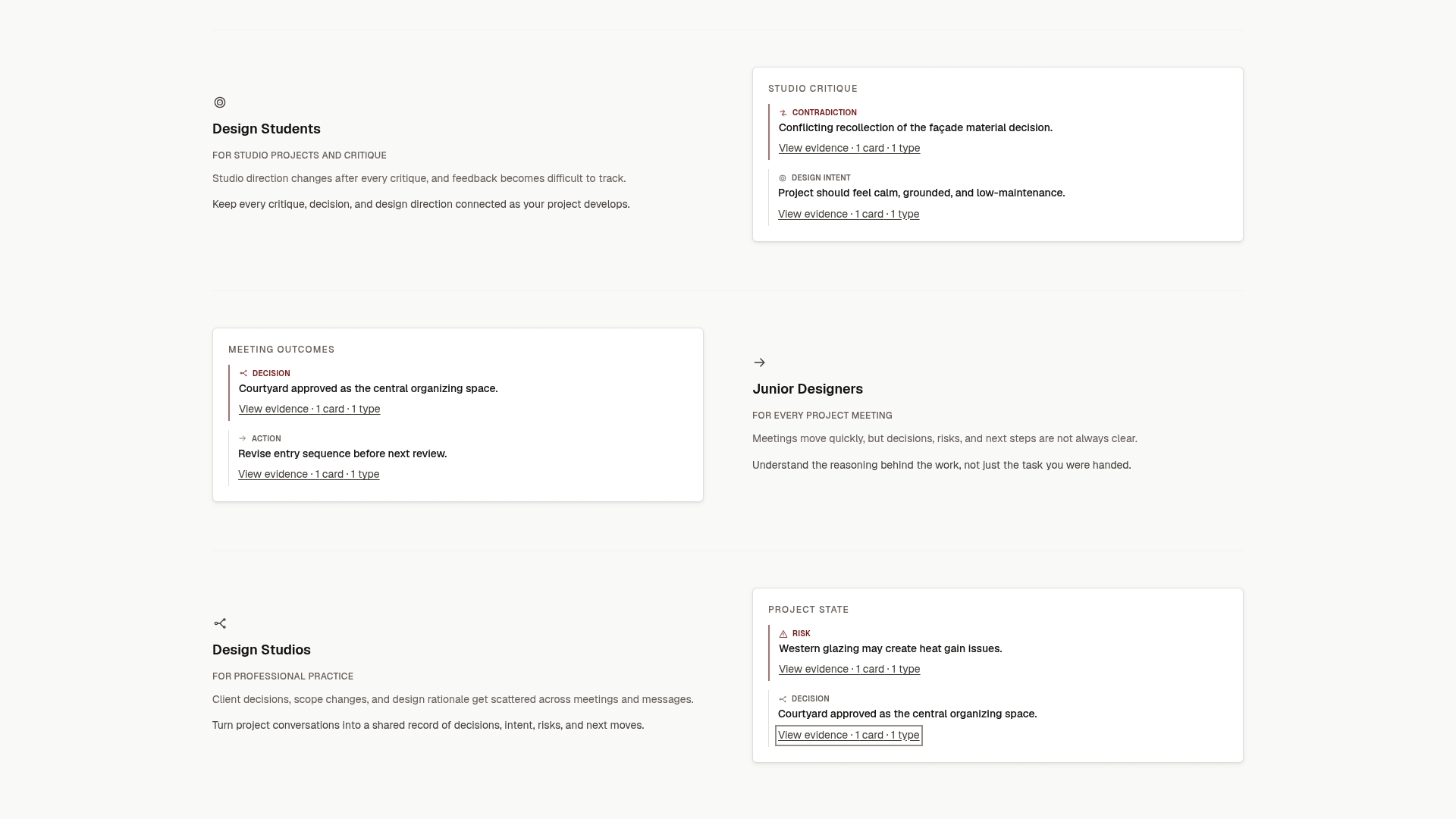
To see how the product approaches decisions, intent and project memory for design teams, start from The Intent Ledger.
FAQ
What is the difference between rationale and justification?
Rationale explains the reasoning behind a decision: the context, the options and why one was chosen. Justification argues that the decision was right, using evidence, standards or logic, often against criticism. A rationale is written to be understood, and a justification is written to be accepted.
Can something be a rationale and a justification at once?
Yes. In everyday practice they overlap, and a thorough rationale often contains the material a justification needs. The distinction matters when time passes or when someone disagrees: you then need to know which parts are the honest account of how the decision happened and which parts are the argument for it.
What is the difference between a reason and a justification?
A reason can simply explain why something happened or was done. A justification adds the claim that the action was correct or permissible. Philosophers describe this as the line between explanatory reasons and normative reasons, which count in favor of an action (Stanford Encyclopedia of Philosophy).
Should every design decision have a written rationale?
No. Focus on decisions that are costly to reverse, disputed within the team, or central to the quality of the final design. Routine choices with an obvious answer do not need a record, and over-documenting makes the important records harder to find.
How do I stop a justification from becoming a rationalization?
Write the rationale first, name the alternatives you rejected, and mark which reasons were facts and which were assumptions. Then ask whether you could defend the choice publicly and accept the same reasoning from someone else.
Sources
- Dictionary.net: justification vs rationale
- Stanford Encyclopedia of Philosophy: Reasons for Action
- Darden Ideas to Action: Ethical Business Decisions
- University of Melbourne: Writing a rationale
- University of Colorado: Making Argumentation Serve Design
- Dix et al.: Human-Computer Interaction, design rationale
- Design Science: Feature, specification and evidence framework